Most veterinary leaders I talk to can name someone on their team who hasn't really gotten better in a long time. Their skills today look like their skills a year ago. Their approach to clients hasn't shifted. The same handful of conversations keep showing up at every Monday meeting.
It's tempting to call that a personality issue, or a motivation problem, or a hiring mistake. More often, it's a leadership issue, and we're the leader.
The work gets done either way. The schedules clear, the appointments run, and the lobby empties at the end of every day. The question that doesn't always get asked is whether the team is actually different than they were six months ago: more confident, more capable, more skilled at the things that used to throw them. And what would it look like if we asked ourselves that question every Monday, instead of saving it for December?
Why Progress Doesn't Happen on Its Own
Most people I work with want to feel like they're getting somewhere. The technician who finally gets a tricky placement reliable wants to learn the next skill. The CSR who handles a hard client conversation without going home rattled wants to take on the next one. The associate who runs a clean solo surgery is already thinking about what they'll do differently next time.
That cycle is the one a leader is trying to start in everyone they work with. And here's where it gets harder than it sounds. The cycle doesn't start on its own. Practices that have it running aren't lucky. Somebody, usually the person at the top, is leading it.
What it looks like when nobody's leading it
The same problems show up in the same places. The same complaints come back from the same kinds of clients. Team meetings turn into operational updates with no real growth conversation in them. People who started strong drift into doing the same job they were doing two years ago. Some of them stay because they like the team and the routine is familiar. Some of them quietly start looking elsewhere.
It usually doesn't feel like a crisis. A practice can run this way for a long time before anyone notices that the team isn't actually moving anywhere.
What it looks like when someone is
The conversations are different. People talk about what they want to learn next. There are stretches of real practice work between team meetings, not just status updates. The technician who was anxious about hard cases has a plan to work toward them. The associate who was avoiding tough client conversations has someone walking through the next one with them. Mistakes get treated as practice reps rather than performance failures.
This doesn't mean the practice is calm or that everyone's hitting their goals. It means progress is something the team is actively making, not something they're hoping happens.
What a Veterinary Leader Can and Can't Do

This is where leaders cross themselves up most often. They take on what isn't theirs to do, or they don't take on what is.
What's not your job
You can't make anyone progress. You can't motivate them from the outside. You can't take their reps for them, or run their hard conversations, or do the practice work that turns a skill into a habit.
What is your job
What you can do is set the conditions. You can ask the questions that help people think bigger. You can help them see what better could look like for their role specifically. You can stop solving every problem yourself so they get the reps they need. You can clear the roadblocks they can't see past on their own. And you can spend real time on the people side of the work, not as an interruption to the schedule but as part of it.
The cycle of progress is something a leader works at. It isn't something a leader fixes once.
Two questions
Two questions help with most of this. The first is about your team: what does "better" actually look like for each person, in their own words? Not what we'd project onto them. What they'd say if we asked. The answer is rarely what we'd predict, and it's almost never the same for two people.
The second is about you: where on next week's schedule is there real time for your own learning? Not the time you hope shows up. The time you've actually put on the calendar. The cycle of progress doesn't usually keep going for the team if it stops for the leader.
There are more questions in this vein. We've put together a printable list of seven for you to download. The free PDF is here.
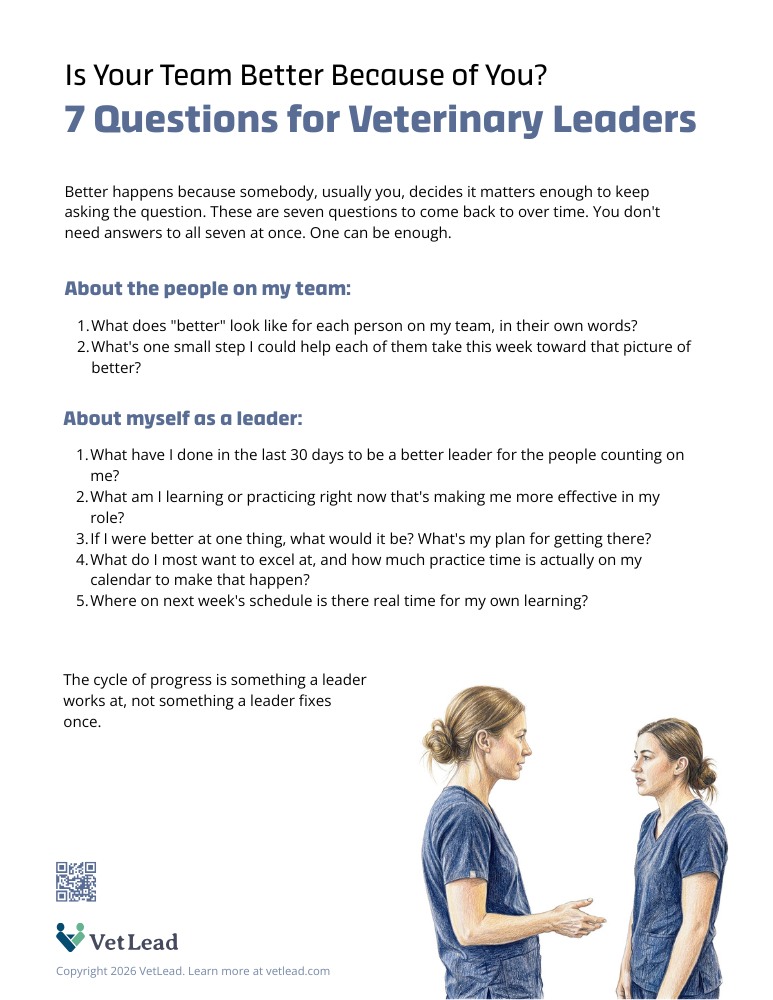
Free Download
Get this pdf leadership resource free. No email address required.
Two Versions of Leadership
There's a version of leadership that's mostly about getting through the day. The work gets done. The schedules clear. The lobby empties. And tomorrow the team is approximately where it was today. A practice can run that way for years.
There's another version. The team is sharper than they were a year ago. The people who were quiet are speaking up. The technician who wasn't sure they belonged is starting to mentor someone newer. That version doesn't happen by accident. Somebody is leading it.
So, is your team better because of you? It's a question we can come back to every few weeks, not just every December. Not because we need a reason to feel bad about how it's going, but because the answer tells us where the next bit of leadership effort wants to land. Better happens because somebody, usually you, decides it matters enough to keep asking the question.