I've worked with a lot of veterinary practices over the years, and there's a pattern I keep seeing in the ones that struggle to hold onto their best people.
It usually starts with a conversation that sounds like this: "I don't understand why she left. I thought she was happy here. We're busy, sure, but everyone is. She had great benefits, good pay, and we all liked working with her."
The owner is genuinely surprised. The departure felt sudden, unexpected. But when I dig into what happened in the months leading up to that resignation, the pattern was there all along.
The Pattern Most Leaders Miss
Here's what it looks like.
The practice gets busy. Maybe you lose someone and can't fill the spot right away. Maybe client demand surges. Maybe it's just the natural rhythm of veterinary medicine where the busy season hits and doesn't let up.
When that happens, leaders often shift into survival mode; the focus becomes getting through today. Appointments need to run on time, clients need to be served, and cases need attention. There's no bandwidth for anything that doesn't feel urgent.
So development stops.
What’s Really Happening
It’s not intentional - no one decided growth didn't matter. But coaching conversations get pushed off and one-on-ones don't happen. The feedback your team gets becomes more task-focused: "Can you get that client checked in?" or "We need to move faster in treatment." There's no time to ask, "How are you growing this week?" or "What do you want to get better at?"
The more time you spend managing underperformance, the less time you have to develop your stronger performers.
Those questions lead to completely different leadership behaviors. One just manages tasks. The other builds capability.
Capability is one of the core outcomes of engagement. When people are engaged, they look for ways to learn more. They want to try new processes, take on new challenges, and become more capable over time. That drive to improve is what makes great employees great.
But if no one is investing in their growth, that drive has nowhere to go. You're not building capability anymore. You're just assigning tasks. And your best people can feel the difference. Your best people notice this shift.
Great Veterinary Employees Search for Growth
Talented people need growth. They need to feel like they're moving forward, building capability, becoming more than they were six months ago. When that stops happening, they start looking around. Not out of disloyalty, but because growth matters to them. And if they can't find it here, they'll find it somewhere else.
Now your practice is even more short-staffed and the workload increases. You're even deeper into survival mode than before, which means even less time for development. The cycle accelerates.
The Cost of the Pattern

Once you lose your best performers, you're left managing the team you have, not the team you need.
Research shows that managers spend about 17% of their time dealing with underperformers. That's nearly one full day every week spent addressing poor performance, managing conflicts, or trying to get people to meet basic expectations. That’s an entire day, every week, spent managing problems instead of building capability.
And here's where the cycle gets vicious. The more time you spend managing underperformance, the less time you have to develop your stronger performers, which means more of them leave. Then you’re left with an even higher percentage of underperformers, which takes even more of your time.
Losing Great Employees Leads to More Problems
You wanted to focus on growth, on building something better. Instead, you're stuck firefighting. And the fire keeps getting bigger.
Here’s something I share when I work with teams: disengaged people create problems, and engaged people solve them. When you lose the people who solve problems, you may find yourself left with people who create them. That's not a judgment on anyone's character. It's just what happens when development stops and engagement fades.
Breaking the Pattern
So how do you break this cycle?
It's not about finding more time; I know you don't have extra hours sitting around, and you probably feel like you don’t have enough. The answer isn't working longer or hiring faster, though both of those might help. The answer is about what you prioritize with the time you do have.
When you're in a conversation with a team member, even a brief one, are you only focused on today's tasks? Or are you also thinking about their growth? When you gather the team for a huddle or a meeting, are you just reviewing what needs to get done? Or are you celebrating progress, recognizing improvement, and helping people see how far they've come?
Leadership Development Can Happen Fast
Development doesn't always require an extra hour. Sometimes it's a 30-second comment: "I noticed how you handled that difficult client yesterday. That took patience, and it made a difference." Sometimes it's a question in the middle of a busy day: "What's one thing you're working on getting better at this week?"
The veterinary practices that hold onto their best people aren't the ones with the lightest workload. They're the ones where leaders stay focused on the journey, not just the destination. They're the ones where growth is still happening, even when things are hard.
You can't eliminate the busy seasons. You can't always control staffing challenges or client demand. But you can control what you pay attention to. And when you stop paying attention to growth, you start losing the people who care about it most.
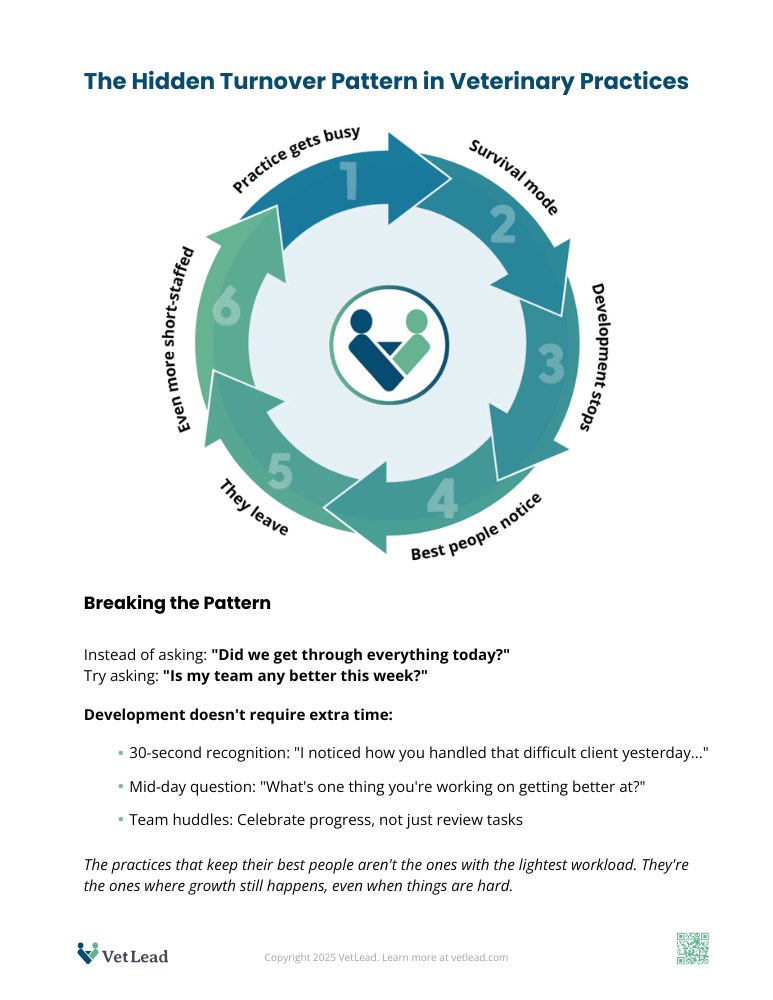
The Hidden Turnover Pattern Veterinary Managers Miss
Download this free resource and use it to evaluate how you approach recruiting and hiring. No email address required.
Where Does Your Veterinary Practice Stand?
Here's a question worth thinking about: which pattern is your practice in right now?
Are you building a team that's more capable this month than they were last month? Or are you just trying to get through the week?
If it's the latter, your best people are noticing. And some of them are already thinking about what comes next.
The good news is that patterns can change. But they don't change by accident. They change when leaders decide that growth matters as much as productivity, and that the question "Is my team better?" is just as important as "Did we get everything done?"
Your best people are waiting to see which question you'll keep asking.
What pattern do you see in your practice? Share your thoughts in the comments below.