When I was in college, I wanted to be an engineer. I spent a semester learning about vectors in physics class, arrows that represent direction and force. I didn't end up becoming an engineer, but that concept stuck with me. Now, every time I work with a veterinary practice that's trying to change, I see the same physics at play.
Most practices push hard on one or two things when they want something to be different. They send out new instructions, update a protocol, maybe hold a meeting. And then they wonder why the change didn't stick, or why the team drifted back to the old way within a few weeks. What's usually happening is that the other vectors in the practice are still pushing in the opposite direction.
There are eight of these vectors. When they're aligned, change happens faster and with less resistance. When they're not, you're fighting your own practice to get anywhere.
The People Vectors
These are the ones that determine whether your team moves toward the change or away from it. You can get the systems right, but if you miss these, nothing moves.
Clarity
I've watched practices roll out a change and then get frustrated when the team doesn't execute it well. But when I ask individual team members what the change actually looks like in their role, they can't tell me. They heard the announcement. They just don't know what it means for how they're supposed to think, act, or prioritize on a Tuesday morning.
People don't resist change because they're difficult. They resist change they don't understand. If your technicians can't describe what "better client communication" looks like in the treatment area, the change isn't clear enough yet.
Communication
This is where most practices think they've done the work. They've sent the email, posted the memo, maybe even talked about it in a team meeting. But telling people about a change is not the same as helping them think through what it means for them.
A CSR, a technician, and an associate veterinarian will each experience the same change differently. The conversations that matter aren't the ones directed at the whole team. They're the smaller, iterative ones where each group gets to work through the questions: How does this affect my day? What do I do differently? What happens when it doesn't go as planned? Communication about change only works when it's a conversation, not a broadcast.
People don't resist change because they're difficult. They resist change they don't understand.
Leadership
If you want your team to do something differently, you have to go first. I've seen this pattern play out dozens of times: a practice owner announces a change, asks the team to adopt new behaviors, and then keeps operating exactly the way they always have. The team notices. And what they take from it is that the change isn't important enough for the leader to bother with, so it probably isn't important enough for them either.
Going first doesn't mean being perfect at the new thing. It means being visibly willing to try, to struggle with it, and to stick with it even when it's uncomfortable. That's what gives your team permission to do the same.
Coaching
Organizational change comes down to individual change. Your practice doesn't become different unless the people in it think and act differently. And one of the most effective levers you have for changing individual behavior is coaching.
Practices with strong coaches adapt faster. Their teams build new skills more quickly, recover from setbacks more easily, and sustain changes that other teams abandon after a few weeks. If you're trying to lead a significant change without investing in how you coach people through it, you're making it harder than it needs to be.
The System Vectors
These are the structural realities of your practice. They either reinforce the change you're trying to make or quietly undermine it. Most leaders underestimate how much these vectors matter.

Culture
Every change touches your practice's culture, which is really just the collection of habits your team has built over time. Those habits are comfortable, and they're persistent. When you ask people to work differently, you're asking them to give up what feels familiar and step into something that feels uncertain.
That transition is going to be uncomfortable for a while. If your culture punishes mistakes or discourages questions, people will default to the old habits the moment things get hard. If your culture treats learning as part of the job, they'll push through the discomfort because they know it's safe to try and stumble.
Structure
As practices grow, how they're organized has to grow with them. Sometimes the reason a change isn't taking hold is structural: the teams that need to collaborate are siloed, or the reporting lines create bottlenecks that make the new way of working unrealistic. Changing the structure is one way to remove walls between teams and make room for the communication and collaboration that change requires.
Process
This one is subtle and easy to miss. A practice can say it wants to operate differently while leaving every existing process in place. If your check-in process, your scheduling workflow, or your inventory system were all designed for the old way of doing things, they'll keep pulling your team back toward it. When you're planning a change, look at the processes your team uses every day and ask which ones support the future you're building and which ones are anchored to the past.
Talent
There has to be a strong link between what you want your practice to become and the people you're hiring to get there. Do you need people who take initiative, or people who follow established protocols closely? Do you need creative problem-solvers, or steady operators? You may need all of these, and if so, you need leaders who can engage a diverse team and move them in the same direction.
Too many practices recruit using yesterday's criteria while trying to build tomorrow's team. If the people you're bringing in don't match the direction you're headed, you're adding vectors that push against your own change.
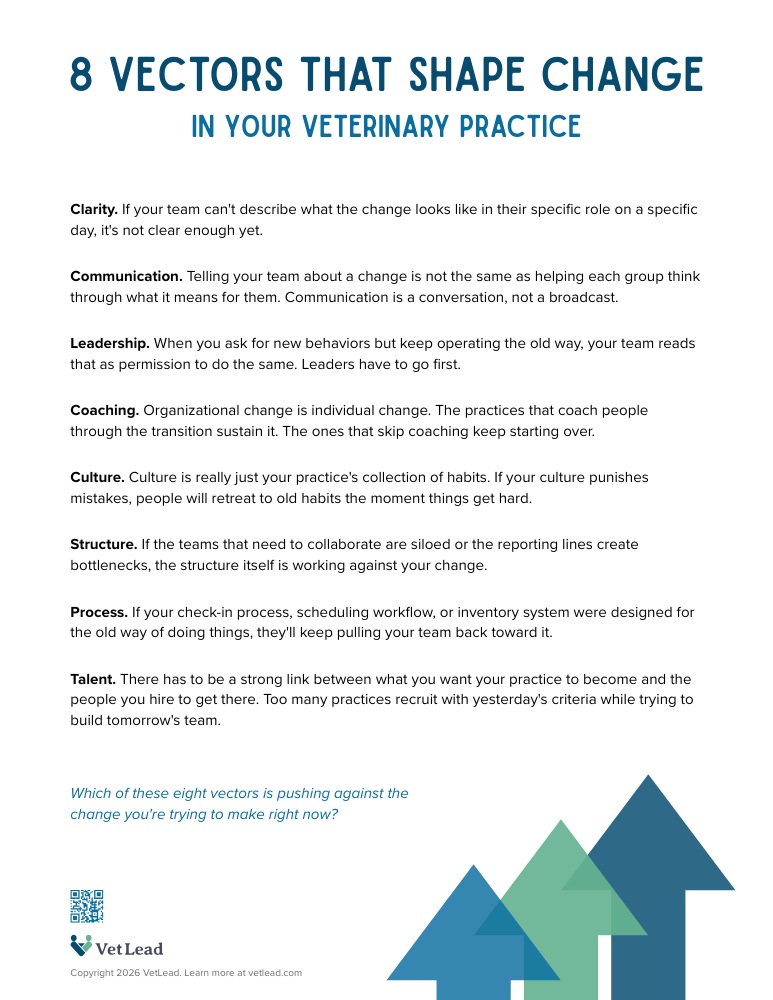
8 Vectors That Shape Change
Download this PDF Now. Share it with leaders and teams. No email address required.
Getting All Eight Vectors Pointed the Same Direction
No practice gets all eight of these perfectly aligned. But the ones that struggle most with change are usually the ones pushing hard on one or two vectors while ignoring the rest. They invest in communication but skip the coaching. They change the process but don't address the culture. They ask the team to change but don't go first themselves.
The next time you're planning a change in your practice, whether it's a new protocol, a shift in how your team handles client interactions, or a bigger cultural shift, run it through all eight. Ask yourself which vectors are pushing with you and which ones are pushing against you. That's where the real work is.
Leading change is easier with a plan and a team to think with. The Veterinary Leadership Program is a 12-week cohort built for veterinary leaders who want a clear, sustainable system for leading their practice through change. Learn how it works.
What do you think? Let us know in the comments section below.