Most managers in veterinary medicine care about their teams. They work long hours in chaotic environments, and they want their practices to succeed. But as humans, we can sometimes fall into patterns and habits that don't support the growth and goals of our team. Here are three warning signs I've noticed that may tell you you're not the boss you want to be.
1. You Get Mostly Good News
Your team has learned all about your reactions. They've watched how you take bad news. Maybe you handle it well and help address the issue. Or maybe you don't, and someone ends up getting blamed.
If you're a shoot-the-messenger manager, the news you get is sugarcoated at best and a lie at worst. And you can't make good decisions if they're based on lies.
The Manager Who Thought His Team Trusted Him
I worked with a manager who spent hours telling me how his people trusted him, how they came to him with problems, how he was the person they leaned on. But when I spent time with the team, I learned the truth pretty quickly. They had figured out that if this manager got involved in a problem, someone was going to get yelled at and the fix was going to take twice as long. So they painted a rosy picture whenever they could and solved things on their own.
He had no idea. He thought silence meant everything was fine. It meant his team had given up on him being helpful.
If your technicians and CSRs have stopped bringing you the hard stuff, it's not because the hard stuff stopped happening. It's because they don't trust you to handle it like a grown-up. That's a sign worth paying attention to, because every decision you make without the full picture is a decision built on something that isn't real.
2. You Think Most of the Good Ideas Are Yours

We've probably all worked with a manager who needed every idea to be theirs before it went anywhere. When that happens, people adapt fast. Either they keep their ideas to themselves, or they spend too much time trying to help the boss come to the idea on their own.
When Your Team Stops Thinking
Think about what that does inside a veterinary practice. Your technician notices a better way to handle patient discharge. Your CSR has a thought about how to reduce wait-time complaints. But instead of bringing it up, they run it through a mental filter: "Will my manager accept this? Do I need to frame it so it sounds like their idea? Is it even worth the effort?"
That's a team spending energy managing up instead of making the practice better. And over time, they stop trying. Not because they don't care, but because they've learned that the fastest path to getting something done is to let the boss feel like it was their thought all along. Your team ends up more focused on your perception than on the success of the practice.
Most of these people just want to do their work and make a difference. When they can't, frustration builds. And eventually, the best ones leave to go somewhere they can.
3. You Wouldn't Hire Your Veterinary Team Today
Ask yourself this: if everyone on your team left tomorrow, would you hire them again? All of them?
If the answer is no, you're a bad boss. That may sound harsh, but it's the reality. Your job as a manager is to recruit, develop, and coach a team that contributes to the success of the practice. If they walked out the door and you wouldn't chase them, you haven't built that team.
We All Need a Leader Who Believes in Us
Some of your people may be experienced, high-performing team members. Others may be newer, still developing, still finding their confidence. Both are valuable. But in every case, you should believe they have enormous potential to be successful. If you believe that, your job is to keep coaching and developing them.
If you don't believe it, then those people need someone who does. You owe them the opportunity to work for a leader who sees what they're capable of and can help them get there. Keeping someone in a role where their leader has already given up on them isn't kindness. It's avoidance. And your team sees it even if you think they don't.
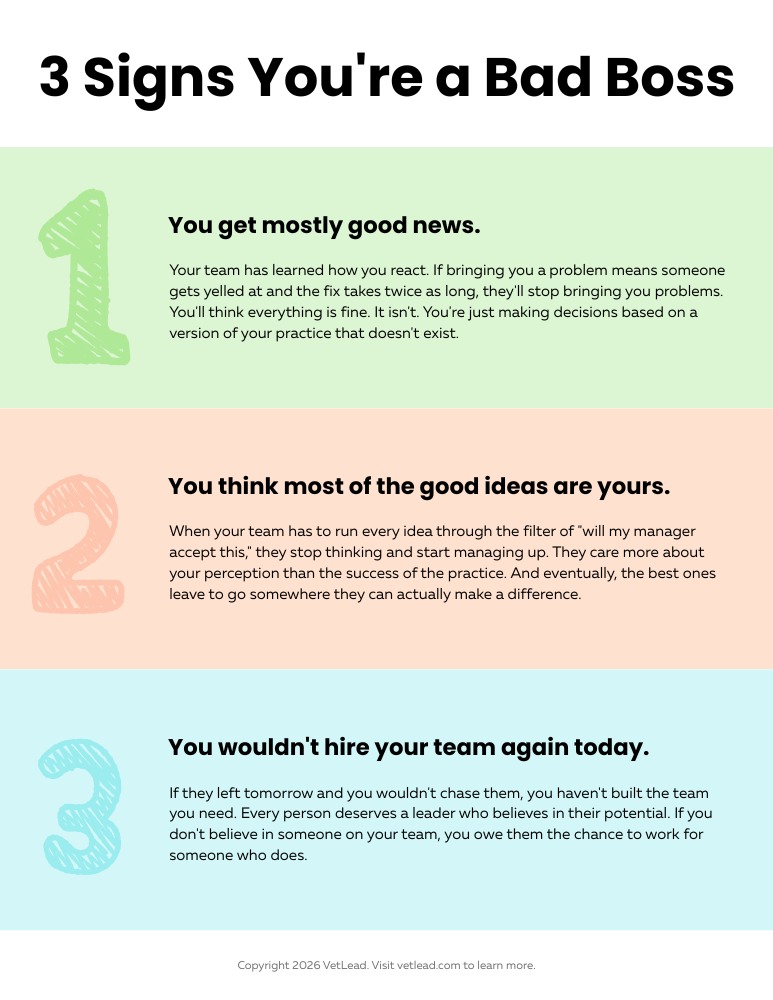
Download this PDF Now
Share it with leaders and teams. No email address required.
Where You Are Isn't Where You Have to Stay
I like to think there are no truly bad bosses. There are people at different places on the journey to becoming great leaders, and what matters is that we keep moving. Sometimes signs like these help us figure out where we are so we can change course.
If you recognize yourself in any of this today, that's just a snapshot. It's where you are, not who you are. But if you're still seeing the same patterns six months from now, that wasn't a circumstance. That was a choice.
What do you think? Let us know in the comments section below.