My dad had a saying when we were working on something together and had completely run out of ideas: "Let's do something, even if it's wrong." It sounds counterintuitive, maybe even a little reckless, but what he meant was that we'd studied the problem long enough and the only way to learn anything new was to act.
I think about that a lot when I watch veterinary teams at work.
When Playing It Safe Becomes the Problem
There's a pattern I see in a lot of practices. A technician notices something inefficient in the client check-in process but doesn't say anything because she's not sure it's her place. A CSR has an idea for reducing phone hold times but keeps it to himself because the last time someone suggested a change, it didn't go well. A practice manager sees a workflow that could be improved but waits for direction from above.
Nobody is being lazy or difficult. They're just being safe, and in most veterinary practices, safe is the behavior that gets quietly rewarded.
What Safe Actually Costs You
Playing it safe has a price, and it's not obvious until you zoom out and look at the whole picture. When your team focuses more energy on avoiding mistakes than on finding better ways to work, improvement slows to a crawl, and you end up with a practice where people are more concerned with keeping everyone happy than with getting better at anything.
That's not a culture problem in the dramatic sense. It's quieter than that, more like a team that has learned, through experience, that new ideas carry more risk than reward.
Your team has learned whether new ideas are welcome.
The question worth asking isn't "why aren't they taking risks?" It's "what have we done that taught them not to?"
If you want to build genuine engagement on your team, that question matters more than most.
What Gets in the Way
Fear of failure is the obvious answer, but it's not the whole story.
A lot of veterinary teams operate under an unspoken rule: bring a solution, not a problem. On the surface that seems reasonable, but in practice it can quietly shut down the kind of early-stage thinking that leads to good ideas. When people aren't sure their idea is fully formed yet, they stay quiet, and that's where innovation stops before it starts.
The Analysis Trap
Leaders fall into this too. Some of us study a problem far past the point where action would have taught us something useful, wanting more information before we decide, more certainty before we move. The challenge is that certainty is often a moving target, and at some point action will teach you things that analysis never could.
The leaders I've watched build genuinely strong practices understand this. They make the best call they can with the information they have and adjust when they learn more, rather than waiting for a perfect answer that may never arrive. That's not recklessness, it's a bias for action, and it matters more than it sounds.
You can read more about what that kind of forward motion looks like in practice here.
What It Looks Like When Leaders Go First

Here's the connection that often gets missed: your team takes their cues from you.
If you're hesitating, over-analyzing, and hedging, they will too. If you're willing to try something, see what happens, and talk openly about what you learned from it, that changes the dynamic over time, even if the shift isn't immediate.
Creating Space for New Ideas
Stopping the habit of solving every problem yourself is one of the most direct ways to open this up. When you consistently step in with the answer, you're sending a message, whether you mean to or not: I don't need your ideas, I've got it. When you ask instead, "What do you think we should try?" you're sending a different one entirely.
That's not about giving up authority. It's about making room for the team to bring their thinking into the work, and when people feel like their ideas are genuinely welcome, they start having more of them.
When Failure Is Part of the Process
One thing I've noticed about veterinary teams that take healthy risks is that failure doesn't derail them, not because they don't care about outcomes, but because they've built a culture where trying something and having it not work is understood as part of learning rather than as evidence that someone wasn't good enough.
That shift is harder to make than it sounds, and it starts with how you respond when something doesn't go the way you hoped. Your team is watching those moments closely, and what you do in them says more about what's acceptable in your practice than anything you could put in a policy.
Teams that feel genuine commitment to their work are the ones willing to try things, and those are the practices that find better ways forward.
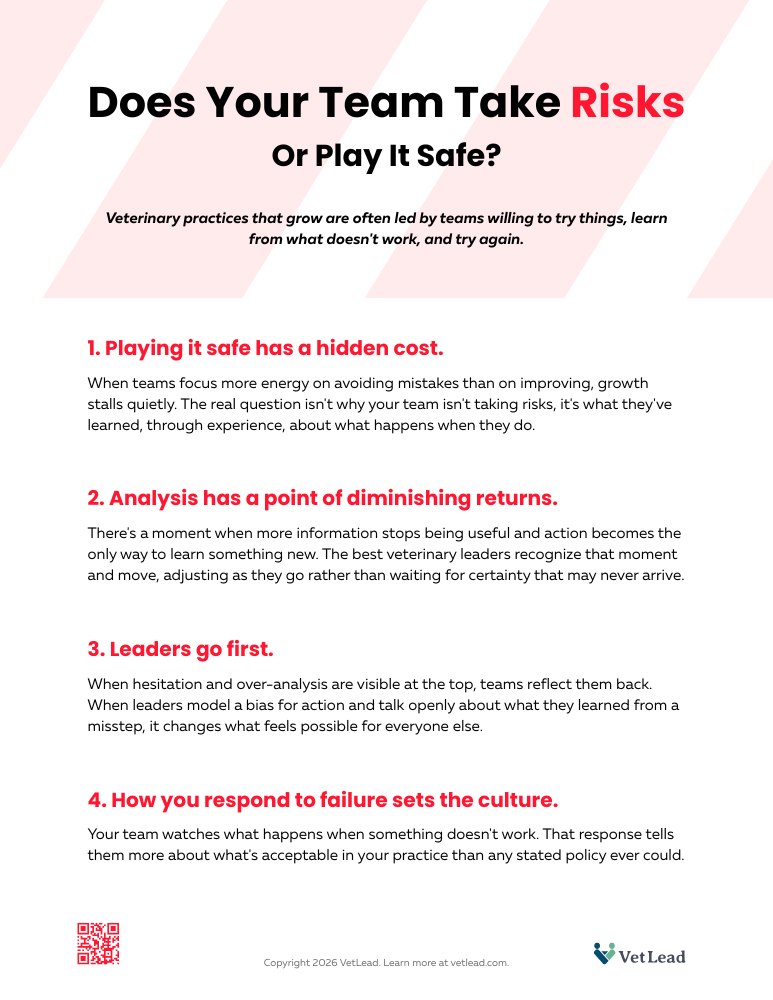
Download this related PDF Now
Hang it on the wall in your team area. No email address required.
A Different Kind of Culture
You won't build this kind of culture by announcing that you want more risk-taking, because that never works.
You build it by modeling it yourself, by asking more than telling, by responding to imperfect ideas with curiosity instead of correction, and by doing something, even if it's wrong, and letting your team see that you can learn from it the same way they can.
Embracing change is never just a team challenge. It's a leadership one first.
What would it look like in your practice if someone brought you a half-formed idea tomorrow? How you answer that, at least to yourself, might tell you something useful about where things stand.
How about your team? Do they take risks and innovate, or do they play it safe? Let others know in the comments below.