Have you ever noticed a teammate struggling? In that moment, do you step in with advice, or hold back because you’re not their manager? That hesitation is where real coaching in a veterinary practice begins.
People hesitate. They think, “It’s not my job. That’s the manager’s role. I don’t have the authority.” It can feel like coaching belongs only to supervisors, not peers or colleagues. But that mindset keeps teams from getting better.
Coaching is not about titles. It is about helping people be more successful. And when more people in a veterinary practice choose to coach, the entire team benefits.
Why Veterinary Professionals Hesitate to Coach
It is easy to see why people hold back. Coaching can feel uncomfortable. A veterinarian may notice a technician struggling and think, “That is not my job to train her.” Or a technician may see a colleague cutting corners and tell themselves, “That is for the manager to handle.”
This hesitation feels safe, but it holds the team back. If we wait for coaching only to come from one person with a title, improvement slows down. Feedback becomes rare. Small problems grow into bigger ones, just like a small wound left untreated can become something more serious.
Comfort and growth Rarely live in the same space.
What often gets in the way is the belief that coaching is about authority. It is not. Coaching is about helping another person make better choices and succeed in their role.
What High-Performing Teams Do Differently
High-performing teams act differently. Everyone is involved in coaching, feedback, and support. A veterinarian helps a technician, a receptionist steps in to help a colleague, and technicians coach each other. People do not stand on the sidelines waiting for a manager to fix things.
That is how teams get better. Coaching works like a scoreboard. It shows people how they are doing, where they are improving, and what still needs work. People change and grow faster with feedback. Without it, improvement is inconsistent and harder to measure.
For example, a receptionist who coaches a teammate on smoother client check-ins creates wins for the entire team. Coaching is not limited to managers. It is part of how high-performing teams build success together.
Coaching Is a Process, Not a Position

Coaching is not about a role or a title. It is a process, a set of steps that anyone can practice to help another person succeed.
Think about it this way: if a friend came to you for advice, you would listen, ask questions, and offer thoughts. That is coaching. You do not need to be their boss to help them move forward.
One simple tool is the permission question. You might say, “I would love to have a conversation with you about something I think could be helpful. Are you okay if I try?” Anyone can ask that. It is respectful, creates space, and opens the door for coaching.
Coaching is not about authority. It is about being willing to step in, ask questions, support another person’s growth, and reorganize words into a supportive conversation.
Overcoming the Comfort Barrier
So why do people still hesitate? Often it comes down to comfort. Having a coaching conversation with a peer can feel awkward. What if they take it the wrong way? What if it is uncomfortable?
But comfort and growth rarely live in the same space. Progress is often uncomfortable. Success requires stepping into difficult conversations.
This is why people sometimes say, “It isn’t my job.” Avoiding discomfort feels easier than engaging. But choosing to engage creates opportunities for growth, even when the conversation is not easy. That is why the most engaged practices encourage everyone to coach, not just managers.
Coaching in Every Direction Builds Stronger Teams
Another misconception is that coaching only goes downward, from manager to staff. In reality, coaching should flow in every direction.
- Sideways: Peer-to-peer coaching strengthens collaboration and prevents silos. For example, a technician who helps a teammate improve their skills in surgery makes the whole team more capable.
- Upward: Coaching your boss may sound bold, but it can be valuable. A respectful suggestion about scheduling or workflow can help leaders see how their choices affect the team.
When feedback flows in all directions, practices adapt faster, relationships grow stronger, and the culture becomes more resilient. A practice where coaching only comes from the top is slower and less engaged. A practice where everyone coaches is better equipped to succeed.
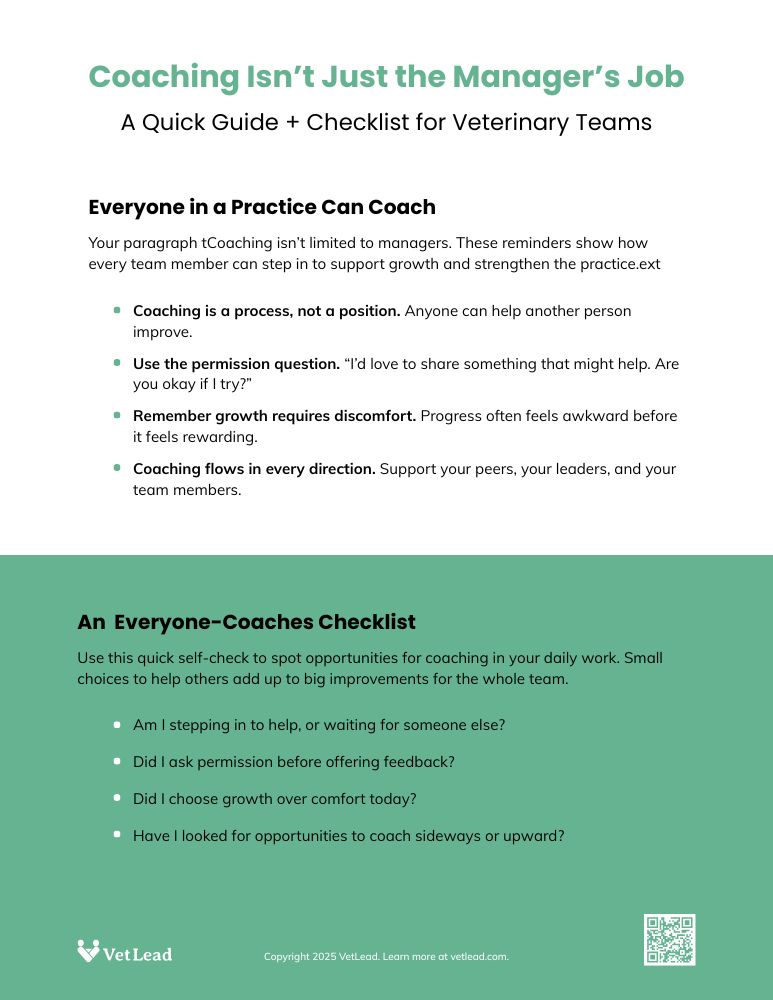
Coaching Isn’t Just the Manager’s Job
Download this free resource, share it with leaders and teams. No email address required.
Choose to Be a Coach in Your Veterinary Practice
Every member of a veterinary team can help others grow. You do not need a title or letters after your name. You only need the willingness to ask questions, listen, and support someone else’s success.
Look around your practice today. Where is one place you could step in with a question or a word of support? It does not take authority to help a teammate improve. It takes a choice to act.
When you choose to coach, you move the entire practice forward. You show your team that growth is everyone’s responsibility. And you stop waiting for authority to do what any human can do: help another person succeed.
Coaching Is Everyone’s Job
So should you coach if you are not the boss? The answer is yes. Coaching is not about titles. It is about choosing to help.
A veterinary practice where everyone coaches is a practice that grows faster, engages more deeply, and delivers better care. The more people who coach, the stronger the team becomes.
Start this week. Practice a permission question. Step into one conversation where you might have stayed silent before. Coaching is everyone’s job, and the sooner we choose it, the stronger our practices will be.
Ready to strengthen your coaching skills? Join the free 30-day Veterinary Leadership Challenge today and start building stronger conversations in your practice.
What do you think? Other veterinary pros want to hear from you! Share your experience in the comments below.