You finished another day. Somewhere between the emergency walk-in, the technician who called out, and the client complaint about wait times, you were supposed to be leading your team. But if someone asked you right now whether you were a good leader today, you probably couldn't answer.
Most veterinary practice managers have no way to measure their own leadership. You got promoted because you were good at your job, not because anyone taught you how to lead. Now you're responsible for a team, but you have no scoreboard telling you whether you're getting better or just getting by.
Years ago, when my son was in second grade, I attended a parent-teacher conference at his school. The teacher walked me through the evaluation system they used for the kids: self-directed learning, communication, problem-solving, asking for help when needed. I remember thinking that these were the same things we should be measuring in leaders. Those seven-year-olds had a clearer growth framework than many grown up professionals don't.
Why Veterinary Leaders Need a Scorecard
Habits run our days. In a veterinary practice, that's especially true because the pace doesn't leave much time for reflection. You react to whatever's in front of you, and by the end of the shift, you've handled dozens of decisions without consciously choosing how you wanted to lead through any of them.
A daily scorecard changes that. It's a short set of questions you answer at the end of each day, and it does two things: it makes you aware of what you're actually doing, and it creates focus on what matters.
Think about how your team acts when you walk into treatment. Think about how you focus differently when someone you respect is observing. A scorecard creates that same effect; you're creating accountability. You decide what kind of leader you want to be, and then you measure whether you showed up that way.
This isn't about adding one more thing to your overwhelmed day. It takes two minutes. But those two minutes can shift how you lead the other eight hours. Small habits like this are often where real change begins.
Four Questions for Your Leadership Scorecard
These are some questions I use with leaders I work with. At the end of each day, give yourself a simple score on each one. Don't overthink it. The value is in consistency, not precision.
1. Did I Teach Someone on My Team Today?

Great leaders look for opportunities to help others learn. But in veterinary medicine, it's easy to slip into just telling people what to do because telling is faster. Teaching means using questions to help someone engage their own thinking. It means letting them work through a problem instead of handing them the answer.
Leaders who stop learning stop teaching. Once someone reaches a management role, there's often a belief that they should have all the answers now. That belief closes the door on their own growth, and it closes the door on developing their team. The best practice managers stay curious. They're still learning, and that's what makes them effective teachers. Proactive coaching works the same way — it's about creating moments for growth, not waiting for problems to fix.
2. Did I Give Positive Feedback Today?
I've done culture surveys in veterinary practices for years, and one theme comes up constantly: supervisors are great at pointing out mistakes, but most team members don't feel recognized for their effort or accomplishments.
This isn't a character flaw; it's how our brains work. Problems grab attention. When something breaks, you notice. When everything runs smoothly, it's invisible. Your default setting as a manager is to find what's wrong so you can fix it.
But your team is running on empty. Staffing shortages, compassion fatigue, difficult clients — they're absorbing all of it. Recognition is fuel. When you notice what someone did well and say it out loud, you're not just being nice, you're giving them a reason to stay engaged. Two sentences of genuine positive feedback can carry someone through a hard week.
Two sentences of genuine positive feedback can carry someone through a hard week.
Building a culture of recognition doesn't require a program or a budget. It starts with noticing, and then saying something.
3. Did I Listen Well Today?
Ask anyone to describe a leader who changed their life, and listening will come up. People are influenced by those who understand them, and you can't understand without listening.
Listening is hard. You're busy. You think you already know what someone is going to say, and you're mentally triaging three other problems while they're talking. But when you slow down and actually invest in what someone is telling you, two things happen: you learn what matters to them, and they feel like they matter to you.
You can't lead someone effectively if you don't know what's important to your team. Listening builds the trust that gives you permission to coach, challenge, and support your team.
4. Did I Help Someone Grow Today?
This one gets lost in the daily chaos, but leadership isn't just about helping people perform their current job. It's about stretching them, challenging them, building their capability for what's next.
Some of the best veterinary leaders I've worked with have a track record of developing people who move into bigger roles. They coach consistently. They look for small moments to give someone more responsibility or push them outside their comfort zone. They measure their own success partly by how many people on their team have grown because of them.
In a profession with frequent turnover, developing your people isn't just good leadership. It's how you build a team that stays.
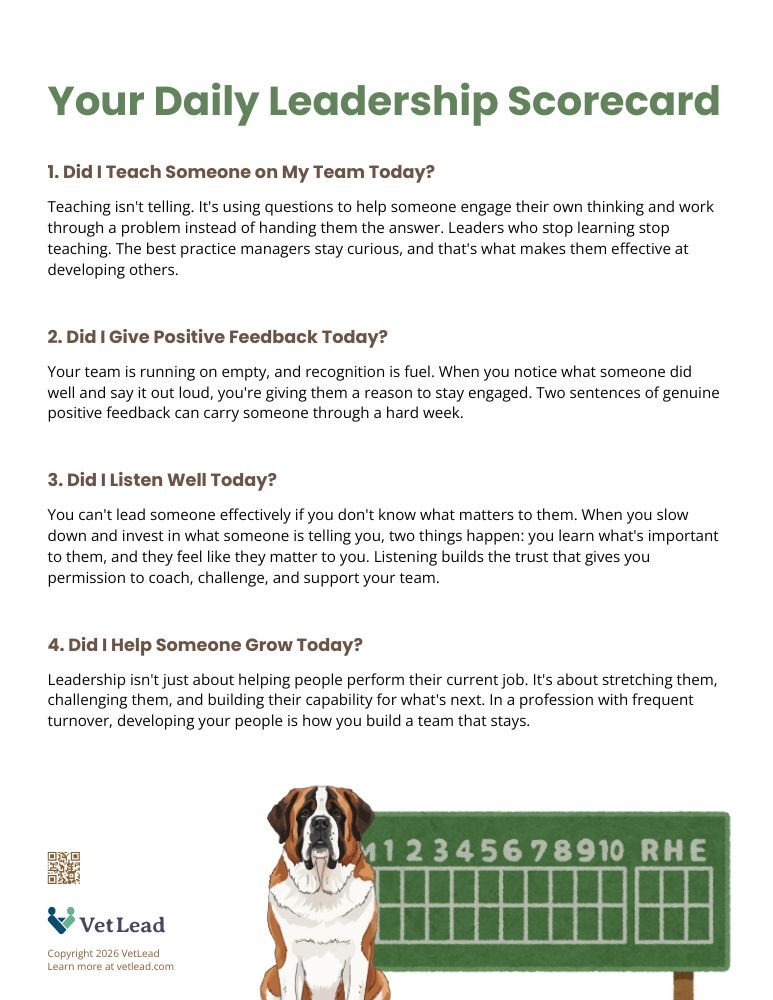
Your Daily Leadership Scorecard
Download and share it with leaders and teams. No email address required.
Making It Stick
Use these four questions, or create your own, and score yourself daily. You don't need a fancy system. A note on your phone works. What matters is consistency.
For extra accountability, commit to sharing your scorecard with someone regularly — a colleague, a mentor, a friend outside the profession. The act of sending it to someone else raises the stakes just enough to keep you honest.
I used to think tools like this were for people who couldn't manage behavior change on their own. I've learned the opposite. These tools are for people who are strong enough to use a support system for the things that matter most.
Veterinary leadership is hard. Nobody trained you for it, and the job doesn't give you much space to reflect. A daily scorecard won't fix everything. But it will help you stop wondering whether you're growing as a leader and start knowing.