I met Jenifer on a bus ride from the airport to a veterinary conference. We talked for maybe twenty minutes. By the time we arrived, I already knew she was a leader.
It wasn't anything dramatic. She listened. She asked questions about other people. She shared her own challenges without making them the center of the conversation. And when the conference started, I watched her get called up for recognition again and again while other attendees kept seeking her out, asking how she was building and sustaining a thriving practice.
She wasn't the practice owner or a lead veterinarian. In the formal hierarchy of her clinic, she didn't hold a "top" title. Yet people consistently gravitated toward her. It made me think about what draws people to certain leaders, and it almost always comes back to one thing: they let people see who they actually are.
Transparency Is a Choice, Not a Strategy
Most of us have been trained to think that leadership means having answers, projecting confidence, and staying composed. And there's a place for composure. But I've watched too many veterinary practice owners confuse composure with distance.
When Confidence Becomes a Wall
Your technicians and CSRs already know when things are hard. They feel it in the lobby. They see it in the surgery schedule. And when you act like everything is fine, they don't think "wow, our leader is so composed." They think you either don't see what they're dealing with, or you don't trust them enough to be honest about it.
That's a hard thing to recover from. Not because your team holds grudges, but because every day you project calm while they're drowning, you're telling them you don't see it. And once they believe that, getting them engaged again is a much longer road.
Letting Your Team See Your Human Side

I've watched practice owners spend thousands on team lunches and retreats trying to build connection. And then I've watched one honest moment do more for a team than a year of those efforts.
Small Moments, Not Grand Gestures
It's not oversharing. It's not dumping your stress on your team during a packed morning of appointments. It's the practice owner who says "I'm figuring this out too" when everyone is adjusting to a new protocol. It's the manager who admits "I didn't handle that conversation well, and I want to try again."
Those moments don't make you look weak. They make you look like someone worth following beyond just a title. Jenifer understood that instinctively. At a dinner table full of veterinary professionals, she participated without dominating. She shared what was working in her practice and treated every conversation like she might learn something too.
Asking Your Team for Help Changes the Dynamic
You probably don't love asking for help. Most veterinary leaders don't. You've built your career on being the person who knows what to do. In a profession where clients trust you with their animals' lives, asking for help can feel like admitting you shouldn't be in the room.
From "I've Got This" to "What Do You Think?"
But when a leader asks for help, something shifts. People feel trusted. They feel like their perspective matters, not just their compliance. I've seen teams go from disengaged and going through the motions to actively problem-solving together. The difference between compliance and real commitment is enormous, and it often starts with one honest question.
When you act like everything is fine, your team doesn't think 'wow, our leader is so composed.' They think you don't trust them enough to be honest.
What does that look like from your team's side? When someone asks for your input and genuinely listens, you feel ownership over the outcome. You're no longer just executing someone else's plan. You're contributing to something that's partly yours. That's how practices start to build cultures where people actually want to solve problems instead of just surviving the day.
Getting Comfortable Saying "I Don't Know"
This one trips up veterinary leaders more than almost anything else. You've spent years building clinical expertise. Clients trust your judgment. Your team looks to you for direction on everything from treatment plans to staffing decisions. Saying "I don't know" can feel like giving up the one thing that earns you respect.
Your Team Can Already Tell When You're Guessing
They can. And when you pretend to know something you don't, you're not just risking a bad decision. You're teaching your team that pretending is safer than being honest. That lesson spreads through a practice faster than you'd expect.
The practice owners I work with who say "I don't know, but let's figure it out" tend to be the ones whose teams bring problems forward early, before they become crises. Their teams speak up in meetings. They offer ideas without being asked. They flag concerns before small issues become expensive ones.
That's not because the phrase itself is magic. It's because it gives everyone else permission to be honest too. And that kind of clarity changes how an entire practice operates.
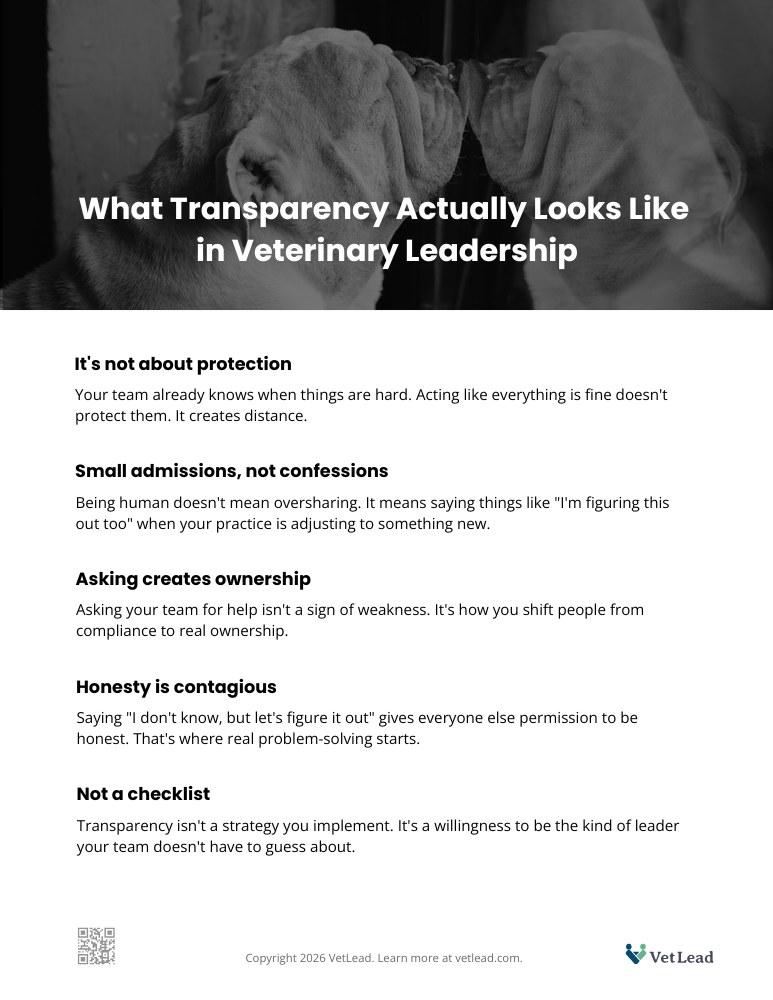
Download this PDF Now
What Transparency Looks Like
Share it with leaders in your practice and others. No email address required.
The Kind of Leadership People Can See
Leadership isn't about position. It's about how you show up. Jenifer reminded me of that on a bus ride, and then proved it over and over throughout a weekend of watching her interact with hundreds of veterinary professionals. She wasn't trying to impress anyone. She was just being herself, which meant being open, being curious, and being willing to let people see who she actually was.
That's what transparency looks like when it's real. Not a strategy you implement. Not a checklist you follow. Just a willingness to be the kind of leader your team doesn't have to guess about.
If your team had to describe your leadership to someone who'd never met you, what would they say? It's worth thinking about. And if the answer isn't what you'd hope for, that's not a failure. That's a starting point.
What do you think? Let us know in the comments section below.