When you’re short on staff in your veterinary practice, everything feels heavier. Phones ring more. Rooms turn over slower. Tempers shorten. You may not change tomorrow’s caseload, but you can change how your team moves through it. That shift can turn a hard day into a better one.
Let’s talk about how we make that shift. There are a few simple moves you can make today, and here are some clear steps that bring calmer flow and a little more control.
Make predictability your safety net
Stress spikes when surprises pile up. You won’t remove every surprise, but you can call out the likely ones before they land. Take a moment to say what you already know.
“Two urgent-care drop offs are likely this morning.” “Mrs. Ruiz will need extra time. Her cat’s meds changed.” “Phones will peak at lunchtime. We will protect two people to cover it.”
Stress comes from things we didn’t expect more than things we expected.
When people expect a tough spot, it feels lighter. They brace for it, organize around it, and recover faster afterward.
Guide a 7-Minute Capacity Huddle
Start the day with a quick huddle. If you have a whiteboard, great. If not, just gather wherever you can for a few minutes. The goal is simple: guide the team toward a better day and make sure everyone shares the same picture.
- Invite one or two “better” goals. Ask, “What would make today feel better?” Maybe it’s smoother handoffs, fewer callbacks after 4 p.m., or making sure lunches aren’t skipped. Write them down or say them out loud.
- Call out today’s pinch points. Two urgent-care drop offs may come in. Phones will spike at noon. Ms. Jone’s cat will take extra time. Naming them up front lowers stress when they happen.
- Clarify roles and coverage. Who’s on phones, triage, pharmacy, and who is backup.
- Talk about breaks. Protect lunch and short resets so people know they’ll get one.
- Ask for one request. Each person shares one way the team can support them today.
Seven minutes is enough. The point isn’t to solve every problem. It’s to encourage clarity, give people a little control, and start the day with the sense that everyone is pulling in the same direction.
Give control back with micro-rotations
Long stretches at high-stress stations wear people down, especially on short-staffed days. Shorter rotations are a way to give people back a sense of control and to help them recharge before the pressure builds too high. They don’t have to be complicated, but they do need to be intentional.
Examples:
- Phones for 45 minutes, then switch to rooms for the next block.
- Triage during the morning rush, then pharmacy for a calmer reset.
- Surgery recovery support until noon, then discharge calls in the afternoon.
These quick rotations don’t slow the team down. In fact, they help everyone keep going and make people feel recognized, preventing the quiet frustration that builds when someone feels trapped in the hardest role all day.
Set simple triage rules everyone can follow
Clarity is one of the fastest ways to lower stress on a short-staffed day. When the team knows how to handle add-ons or decide what counts as urgent, they don’t have to stop and ask or argue in the hallway. Decide together what those rules look like, keep them simple, and make sure everyone understands them.
The benefit is twofold. Doctors get interrupted less, clients wait less, and the team feels more confident making decisions in the moment. Predictability steadies the day, even when the caseload doesn’t change.
Make client communication predictable

Clients can handle waiting better than they can handle silence. On short-staffed days, the frustration usually comes from not knowing what’s happening. Build a routine for setting expectations up front and giving timely updates, even if the update is simply, “We’re still working on it.”
The actual words don’t have to be complicated. It might sound like, “We’ll update you periodically, and we’re working to get you seen as soon as possible.” Or it could be as brief as, “We’re working on it, and you haven’t been forgotten.” What matters is that the client hears from you and knows someone is paying attention.
When everyone on the team understands who owns each update or callback, clients feel informed, repeat calls are reduced, and the practice avoids small frustrations turning into bigger conflicts.
Finish the day in a way that builds tomorrow
When the team is behind, the first things tossed are often the small promises. Lunch. A quick water break. Five minutes to close charts. Those are the oxygen of a long day, and when they disappear, so does energy. Protect them early by planning coverage for lunches and setting aside short windows for charting. And if a promise has to be moved, replace it quickly so the team still sees that those commitments matter.
Then, before the day is over, take a few minutes to close with a couple of questions.
- What worked today that we want to keep tomorrow?
- What did we learn that could make the next tough day easier?
Capture the answers on a board or even in a notebook, then start the next huddle by reading them back. That simple loop turns one better day into a string of better days.
Keep the culture clean while you are tired
Hard days in a veterinary practice open the door to gossip and side comments, which can make the next day harder still. You can close that door by creating clarity around the behavior you want.
- Define gossip clearly so people know the standard.
- Don’t let it linger. Address gossip when it’s small.
- Replace it with healthier, direct conversations.
It doesn’t take a lecture to keep standards clear. A simple, consistent message is often enough, especially when the leader repeats it until it becomes part of the culture.
What to do when you are the one who is exhausted
You can’t pour water from an empty cup, and your team can tell when you are out of gas. Be transparent and specific without making it about you. You might say something simple like, “I’m juggling a few extra things today. If you see me with my head down, I’m clearing charts or handling a client call. If you need me, let me know and I will reset.” That gives your veterinary team context, not a complaint. And, it gives them permission to be honest about their own limits.
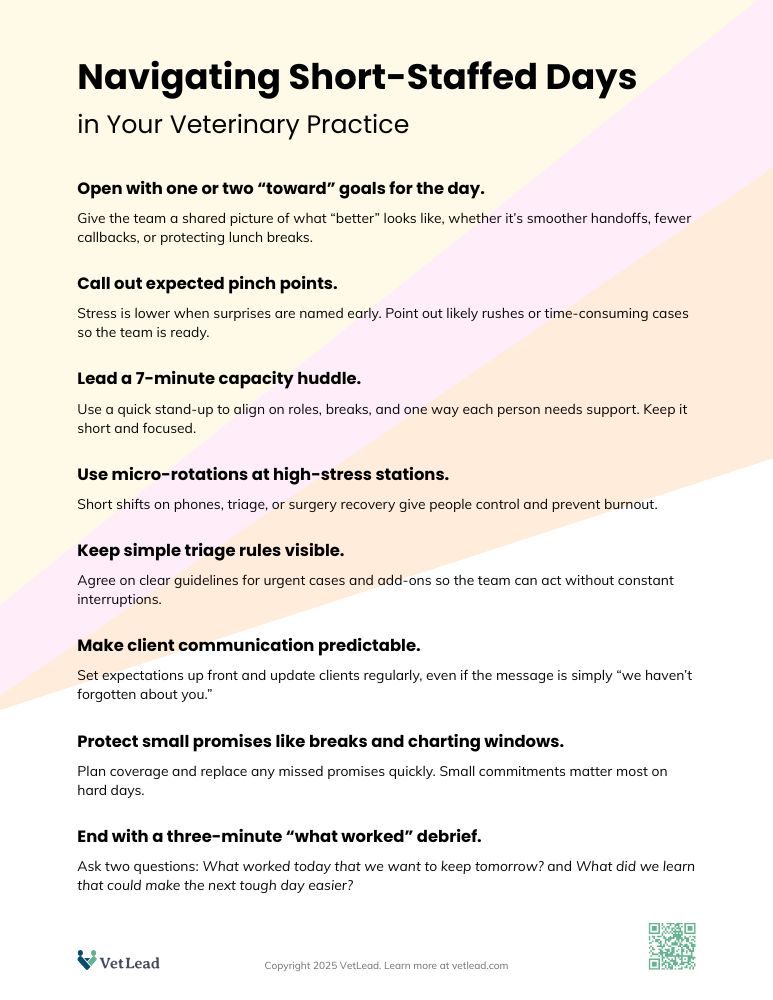
Navigating Short-Staffed Days - PDF
Download this free resource, share it with leaders and teams. No email address required.
Being short-staffed can make your veterinary team stronger
Short staffing will test any hospital. It can also make a team stronger. The key is to give people a shared picture of the day, a little control over how they move through it, and quick routines that make success visible. Do that, and you will see fewer spikes of stress, steadier service for clients, and a team that ends more days saying, “That was hard, but we did good work.”
That is the goal. Not perfect days. Better days, more often.
What do you think? Other veterinary pros want to hear from you! Share your experience in the comments below.