Check our the recording of our latest live event, Build a Fully Accountable Team
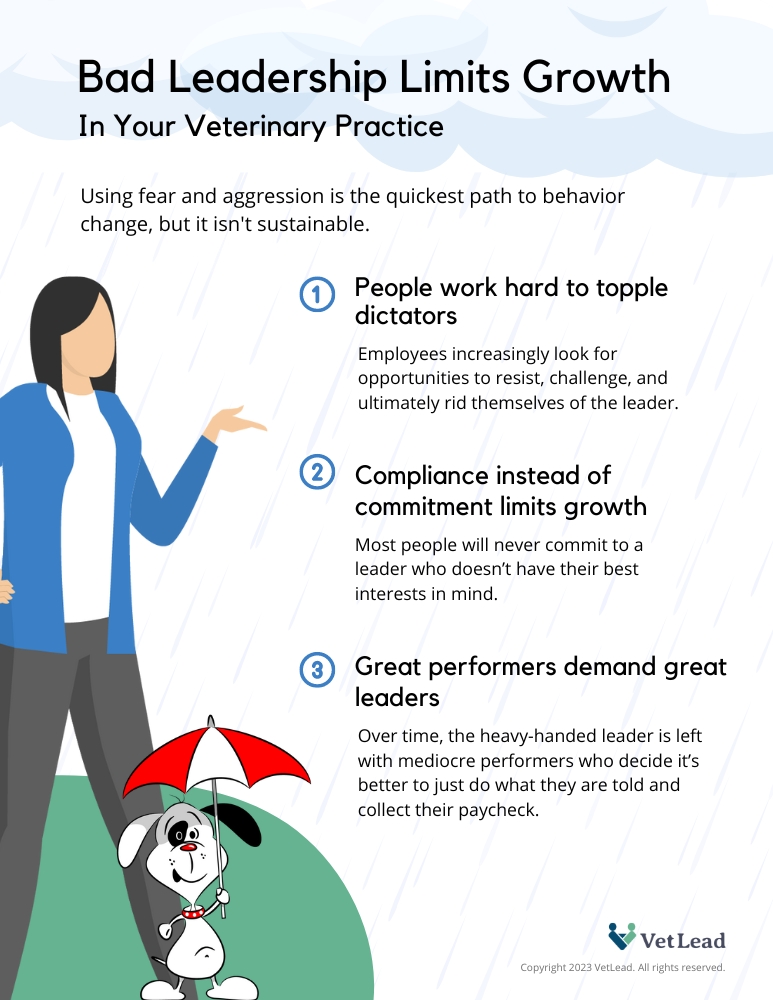
One of the toughest challenges I’ve faced working with leaders is how many of them outwardly appear to be successful. Yet, they have spent much of their time using fear, intimidation, and a draconian approach to managing others. There are far too many examples of people who lead the wrong way and reap the rewards for doing so. Using fear and aggression is the quickest path to behavior change.
What's celebrated in your veterinary practice?
Organizations often celebrate leaders who hit their targets without taking a closer look at how they made that happen. Sometimes, managers who are getting results using a big stick are promoted to a larger role. In this new role, they repeat these poor leadership patterns. They continue to use techniques that are fast, easy, and wrong on their rise to the top. Eventually, they get to a place where aggression is their only leadership tool and they lose the ability to make things happen.
Leaders who don’t learn from their mistakes typically derail at some point. This is because eventually, fear and intimidation no longer work with their team. Fear as a tool is fast, but it’s not sustainable.
Over time there are three major dynamics that come into play with leaders who follow this pattern.
1
People work hard to topple dictators
As this kind of leader goes about his or her job, larger and larger numbers of people become negatively affected. Employees increasingly look for opportunities to resist, challenge, and ultimately rid themselves of the leader. At some point, the outcry becomes so loud that someone who has the power to make a change, hears it.
The Veterinary Leadership Program
Get info on this exclusive program.
Learn how to:
- 1Build an accountable team
- 2Make change happen
- 3Improve performance
- 4Hire exceptional talent
Includes live coaching.
Investment will be $897 per person
2
Compliance instead of commitment limits growth
When you haven’t had compliance in your practice, it looks like a great thing at first. People begin to do what they are supposed to and that brings results. However, over time, compliance causes mediocrity. At that point, only commitment will be able to consistently grow a practice.
Most people will never commit to a leader who doesn’t have their best interests in mind. Employees will also turn away from a practice that allows this kind of leader to stay in place. People become disgruntled and many decide to do just enough to get by, but never really commit to the success of the team or the practice.
3
Great performers demand great leaders
The best employees will decide they can achieve more under a leader who helps them grow and develop. Consequently, this might mean changing hospitals to find one. Star players understand that a great coach will make them even better. Over time, the heavy-handed leader is left with mediocre performers who decide it’s better to just do what they are told and collect their paycheck. No one can win for long with a team like that.
Takeaways
Download this shareable PDF, free. No email address required.
Bad leadership seems to work when you are only looking at a snapshot. There will always be managers that are willing to take the easy road and just tell people what to do. Also, there will always be practices that reward that kind of leadership and continue to promote those who practice it.
If you want your hospital to be built on a foundation that is sustainable, you need leaders who develop trust and commitment from the teams they lead. It will always take longer, but it will always be worth it. Leadership shortcuts can be seductive in a world focused on immediate gratification. However, your practice can’t afford to encourage or tolerate these leaders without suffering the long-term consequences they always bring.
Is bad leadership happening in your practice? Let us know what you think in the comments section below.
Thanks Randy this is so validating !