I often get to work with veterinary managers who are entering into a leadership role for the first time. This is some of the most rewarding work I do. There's no universally approved handbook on leadership, and many of us struggle tremendously at first.
Leading a practice grants you some authority, and all of a sudden you're accountable for not just what you do, but for what others on your team do as well. That's a big shift, and it's one of several challenges new veterinary leaders face that can feel overwhelming at first.
Here are four things I share with every new leader I work with.
1. Your New Authority Is an Opportunity, Nothing More
Sometimes new supervisors decide that because they're now in charge, they get the respect, loyalty, and commitment of others. What they really get is a chance to earn those things.
People will decide very quickly whether they will trust you and work hard for you. The alternative is that they'll tell you what you want to hear and do just enough to get by. You get to determine that outcome by how you work with your team. It's not guaranteed, or even easy, but you have a shot at it now.
Which kind of leader do you want to be?
2. Veterinary Leaders Don't Need All the Answers

Many new leaders feel like they have to become the source for all ideas and solutions. When they get questions, they feel like their job is to have every answer. Nothing could be further from the truth. In most cases, their job is to build a more capable team that's effective at solving problems.
No team is very successful if they have to run to the boss for all the answers. I've written before about why veterinary leaders need to stop solving all the problems in their practice, and this is where it starts.
Helping Your Veterinary Team Think
It's critical that you ask the right questions to help your team anticipate challenges and opportunities. This helps your team think about issues before they become a crisis.
When a technician comes to you with a client complaint, instead of telling them what to do, try asking: "What do you think would work here?" When there's a scheduling conflict, instead of solving it yourself, ask: "If you were going to fix this, where would you start?"
You're not abdicating responsibility. You're building a team that can think and problem-solve and grow. This is what becoming a better coach looks like in practice.
3. What You Do Matters More Than What You Say
I hear a lot of practice managers say things like, "I told them to be honest with me," or "I told them that I wanted their ideas," or "I told them I would listen to anything they had to say."
What you say now means less. It's what you do now that means more.
Here's what I've learned: people on your team do not care what you tell them. In many cases, because you're now in management, their first instinct is to not believe what you say anyway. They care about what you show them.
How Your Team Decides What's True About You
If you want new ideas, candid feedback, or open conversations, you have to create an environment where that is expected and rewarded. Understanding what makes feedback effective can help you get this right.
What you say now means less. It's what you do now that means more and affects more people. In veterinary practices especially, where the pace is relentless and emotions run high, your team is watching how you respond under pressure. They're learning what's really true about you based on what you do, not what you say.
4. You Don't Have to Keep Your Team at a Distance
Lots of new leaders trip up on this one. They believe that in order to effectively lead people, they have to remain aloof and detached. The belief is that they can make better decisions and not be perceived as being friends with anyone on the team.
The truth is, if you're a good leader you will develop a relationship with every person on your team. Furthermore, each relationship will be a little different. You have to learn what drives them, what they care about, and what causes them to fully engage.
You can't do that at a distance.
Connection Over Distance
Yes, it will hurt you if you're perceived to be friends with only one or two of your employees. That's why you have to build relationships with all of them.
When you know your people, you can coach them better. You can have harder conversations because there's trust underneath them. You can ask more of them because they know you see them as individuals, not just employees filling a slot on the schedule.
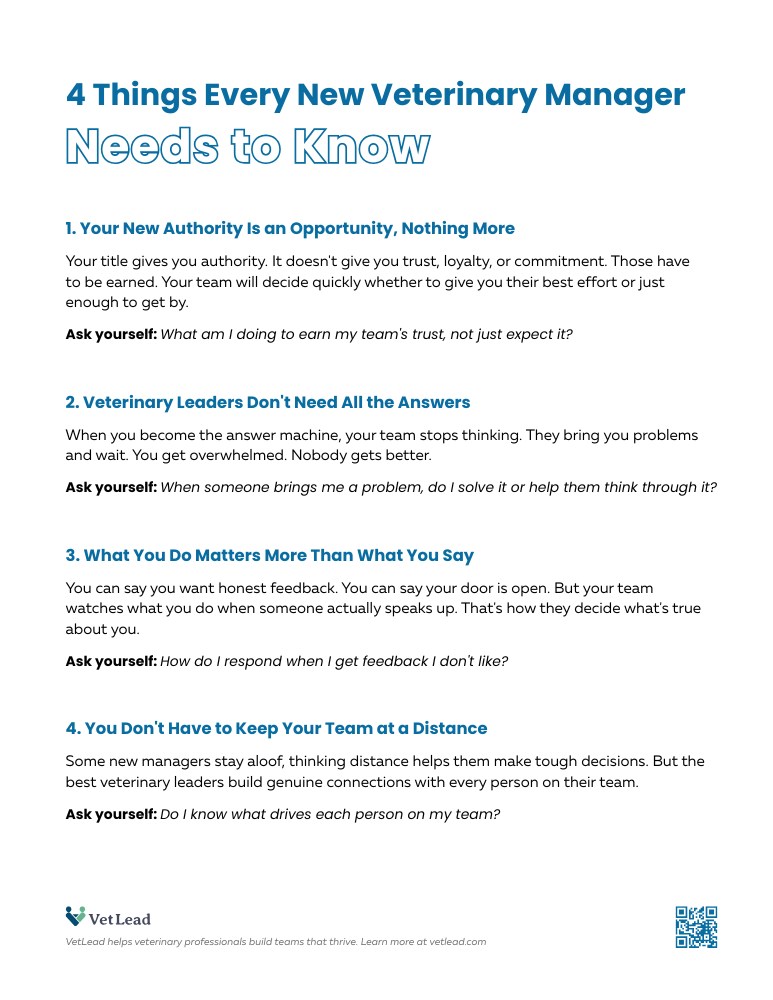
4 Things Every New Veterinary Manager Needs to Know
Share this PDF with leaders and teams. No email address required.
What Changes When You Lead
Leadership will become much more about judgment and less about your individual performance. Now, your job is to create an environment where people take ownership, solve problems, and grow. You're responsible for their mindset, their development, and their results.
That's a big shift. And it's uncomfortable at first because you're giving up control over the one thing you used to control completely: your own work.
This isn't really about you anymore. When you're a new leader, that might be the one thing that matters most.
What would it look like if you started leading that way tomorrow?